 Crypto Daddy
Bitcoin market cycles have repeatedly tested investors’ confidence, patience, and conviction. From the dramatic crash of 2011 to the FTX collapse in 2022, Bitcoin has survived four major market downturns and delivered powerful recoveries. But is history repeating itself once again?
Bitcoin has been declared dead more times than most financial assets have even existed.
Every major crash brings the same headlines. Every prolonged bear market creates the same fear. Investors begin questioning whether Bitcoin’s best days are behind it, while others abandon the market completely.

But when we step back and examine Bitcoin’s history, something interesting appears.
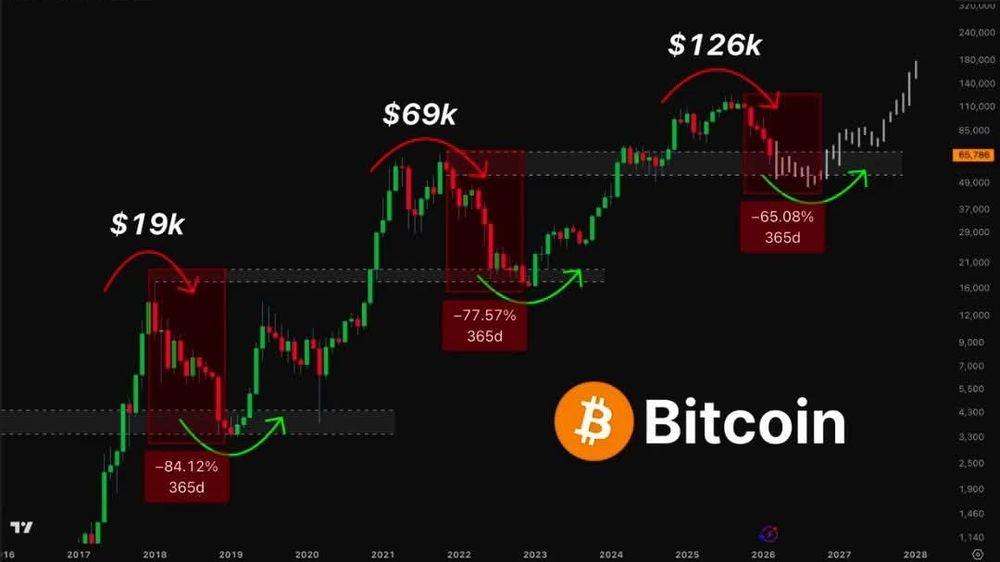
Across multiple market cycles, Bitcoin has repeatedly followed a familiar pattern: a powerful rally, an explosive peak, a brutal correction, a long period of uncertainty, and eventually another major recovery.
It has never been an exact repetition. But the similarities are difficult to ignore.
And today, that history deserves another look.
2011: When Bitcoin Was Almost Written Off
In 2011, Bitcoin was still an experimental technology. The market was tiny, liquidity was limited, and very few people understood what digital money could eventually become.
Bitcoin reached approximately $32 before collapsing toward $2.
For many early investors, that looked like the end.
But the story was far from over.
In 2013, Bitcoin surged above $1,000, transforming from a little-known experiment into a global financial conversation.
The first major lesson was already there: a devastating correction did not necessarily mean Bitcoin was finished.
2014–2015: The Mt. Gox Collapse
The next major crisis came with the collapse of Mt. Gox, once the largest Bitcoin exchange in the world.
The exchange’s failure damaged confidence across the entire cryptocurrency market. Investors questioned the security of exchanges, the future of Bitcoin, and whether the industry could survive such a shock.
Bitcoin eventually fell toward the $150–$200 region during the bear market.
Fear dominated the market.
Yet, over the following years, Bitcoin recovered and reached nearly $20,000 in December 2017.
The market had survived another major crisis.
2018: The Bubble Bursts
The 2017 bull market brought enormous attention to cryptocurrencies.
New investors entered, expectations became extreme, and speculation pushed prices higher.
Then the market turned.
Bitcoin fell from nearly $20,000 to approximately $3,100 by the end of 2018.
The excitement disappeared. Trading activity weakened, and many people believed the cryptocurrency boom had finally ended.
But the next major expansion would take Bitcoin to approximately $69,000 in 2021.
Once again, the market had moved from euphoria to despair and back again.
2022: FTX, Fear, and Another Brutal Bear Market
The 2022 downturn was different in its details, but familiar in its emotional impact.
After the collapse of major crypto companies and the failure of FTX, confidence was severely damaged.
Bitcoin dropped toward $15,500 in November 2022.
The headlines were brutal. Investors questioned the future of exchanges, institutions, and the entire cryptocurrency ecosystem.
But Bitcoin did not disappear.
The following years brought another major recovery, eventually taking Bitcoin to a new all-time high above $126,000 in October 2025.
The pattern had continued — although the size of each cycle’s gains was becoming smaller.
The Multipliers Are Shrinking. The Pattern Is Still Worth Watching.
One important detail often gets overlooked when comparing Bitcoin’s historical cycles.
The percentage gains have decreased dramatically.
The early cycle delivered extraordinary returns. Later cycles still produced substantial gains, but on a much smaller scale.
Bitcoin’s market capitalization has grown, institutional participation has increased, and the asset has become far larger than it was in its early years.
Expecting another 500x move from an already established asset would be unrealistic.
The important observation is not that Bitcoin must repeat its previous returns.
It is that major corrections, long periods of uncertainty, and eventual recoveries have been recurring features of its history.
History can offer perspective. It cannot guarantee the next outcome.
Where Are We Now? The Market Is Asking Another Difficult Question
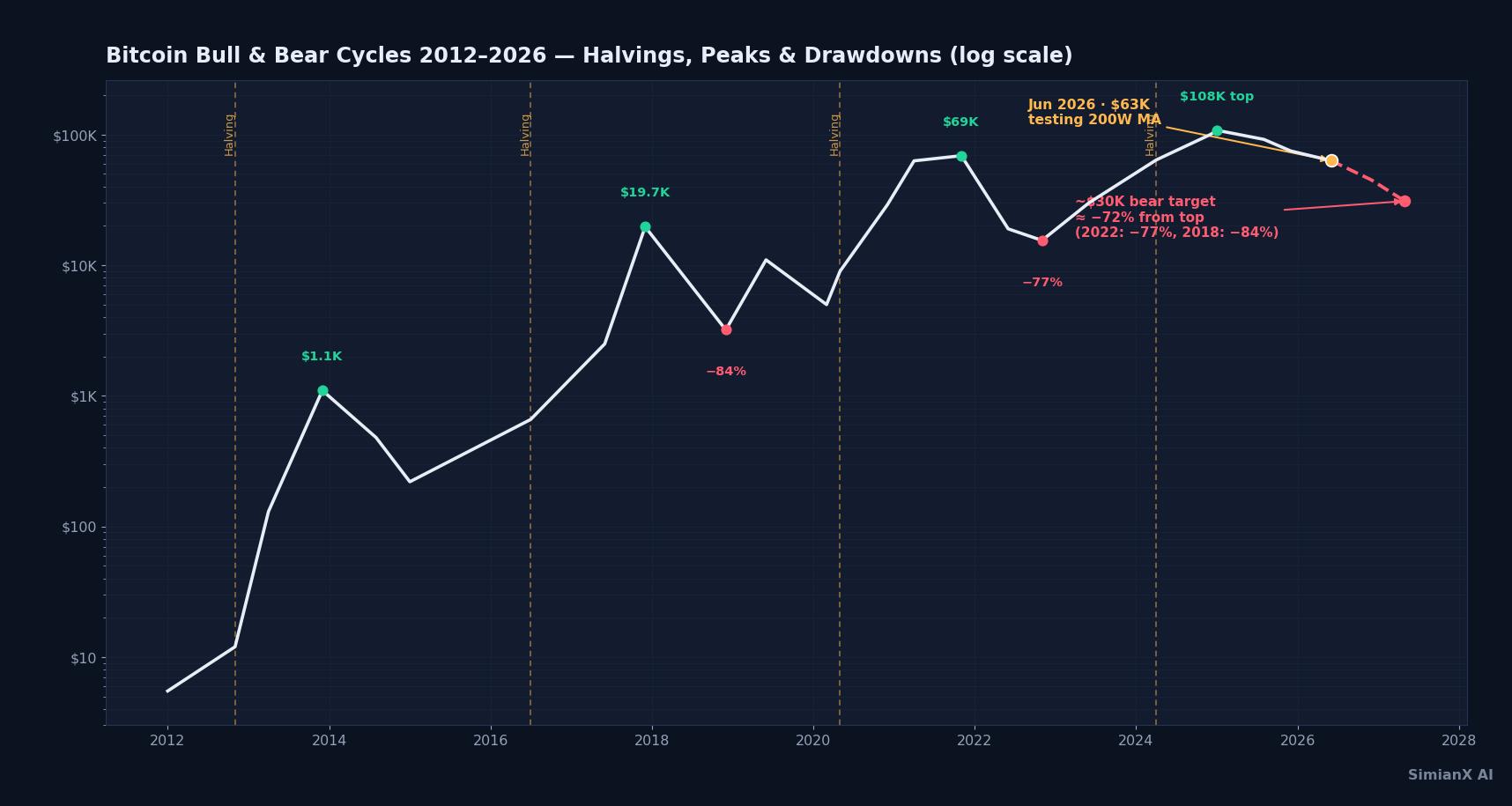
Bitcoin reached an all-time high of approximately $126,080 on October 6, 2025.
As of November 16, 2026, Bitcoin is trading around the $64,000–$65,000 region — approximately 49% below that peak.
That is a significant correction.
And it brings back a familiar question:
Are we witnessing another prolonged bear-market phase, or is the market approaching a point where a new recovery could begin?
Nobody can answer that with certainty.
The fact that Bitcoin recovered from previous crashes does not mean it must recover on a predictable schedule. Every cycle has different economic conditions, liquidity, regulation, institutional participation, and market structure.
This is exactly why traders and investors need to separate historical perspective from blind optimism.
The Boring Phase Is Where Discipline Matters Most
During bull markets, everyone wants exposure.
When prices are rising, confidence is high, social media is full of predictions, and suddenly everybody seems to be an expert.
But during long corrections, the atmosphere changes.
Trading becomes frustrating. Volatility creates uncertainty. Investors lose patience. Many stop paying attention.
This is where preparation becomes important.
Instead of chasing every green candle or panicking during every red one, disciplined market participants focus on important price levels, market structure, risk management, and confirmation.
No FOMO. No FUD. Trust the lines.
The goal is not to predict every move. It is to understand the market, prepare different scenarios, and avoid making emotional decisions.
Final Thoughts: Bitcoin Has Survived Before. What Happens Next?
Bitcoin’s history is full of moments when confidence disappeared.
The crashes of 2011, 2014–2015, 2018, and 2022 all tested the market in different ways. Each was followed by a major recovery, but none came without uncertainty or risk.
Today, Bitcoin is facing another serious correction from its latest all-time high.
Will history repeat itself?
That remains an open question.
But one thing is certain: the market deserves attention when everyone is talking about it — and perhaps even more attention when almost nobody wants to talk about it.
Study the levels. Manage the risk. Wait for confirmation.
NO FOMO. NO FUD. TRUST THE LINES.
— Crypto Daddy 🐺
Disclaimer: This article is for educational and informational purposes only. It does not constitute financial or investment advice. Historical performance does not guarantee future results. Cryptocurrency markets are volatile, and every trading decision involves risk.